How to Make a Business Podcast That Doesn’t Sound Like All the Others
- Scott Murray
- Mar 6
- 10 min read

Updated: Mar 27
Too many business podcasts exist for one reason: because someone realized they could start one.
At that point, another business podcast is created that likely sounds like so many others - interchangeable and one-dimensional.
And by the way, this isn't just limited to business podcasts. The tendency to make podcasts like this is everywhere. I started podcasting in 2011 in the pop culture genre. There was a lot of repetition in format, including several podcasts that just sounded "mailed in." You know:
Hit record.
Talk.
Hit stop.
Upload.

Back then, there were already plenty of shows that followed the same formula. I remember wondering at the time: are they doing this for fun, or are they trying to build something?
Now I find myself asking that same question when I listen to many business podcasts in 2026. And to be clear, either answer is fine. If it’s a hobby, great. But if you’re investing business time and resources into it, I’d assume you want more than “we have a podcast” as the outcome.
The problem isn’t launching a podcast in 2026. The problem is assuming you can take a bare-minimum approach or do it the same way everyone else does and still expect it to stand out.
If your goals are centered around building an audience and brand humanity, the conversation has to start with understanding what podcast listeners are actually experiencing today. This is especially true since business podcasts are still popular.
The Modern Podcast Listener Experience

Reddit threads like the one above often vent about bad audio quality being a deal breaker or repetitive interview questions and episode formats.
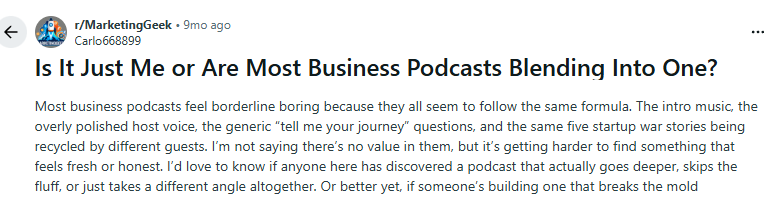
Meanwhile, there is an overwhelming number of options. This alone helps shape how people search, how quickly they evaluate, and how much patience they’re willing to extend to something new.
Additionally, podcasts have become so mainstream now that it's not uncommon for people to listen to multiple shows a week. These folks have built weekly listening routines. So when they try a new show, the window for earning a place in that rotation is small.
By adding a show into the marketplace, you're asking some people to rearrange their routine, and they'll only do it if you give them a good reason. Consider these insights about podcast audiences:
Business podcasts continue to be one of the most popular podcast genres.
Your potential clients might listen to 6-8 podcasts per week for 7+ hours.
Over 70% of listeners want to be entertained and learn new things.
78% of business podcast listeners tune in weekly.
Right now, hitting record for 20 minutes without any creativity or production makes it much harder to gain subscribers. It's also safe to assume they may not be looking for another interview show or another generic tips show. They've already heard those.
Or as Julia Becker Collins says, "A personality cannot sustain a podcast alone. You need great content. You and your guests need to provide new perspectives and insight, not rehashing what others talk about or reading from an AI-generated script. Listeners don’t tune in to just hear someone talk."
What This Means For Your Business Podcast
There are over 14,000 business podcasts in English-speaking countries, and that number grew 34% in 2025 (44% in the US alone). Meanwhile, listeners are scanning through all that, looking for good quality, something unique, and the means to learn something new.
How can anyone risk sounding like so many others, recording with bad audio, or settling for a bare minimum presentation knowing all that?
I always tell clients to listen to an episode or create their first episode and listen to that before publishing. Then ask:
If I heard that, what did I learn?
Why do I care?
What stood out?
Why would I come back to get more?
However, let's assume your audio is good and you have clear goals. You might say, "Scott, all I hear are interview and commentary shows. What else could I do?"
It's a fair question. To answer this, let's look at some things I did when I was in the crowded pop culture genre and see if it helps provide some answers.
The Part-Story, Part Talk-Show Idea
My first podcast lasted about two years and it revolved around interviewing people from TV shows and movies. Around 2013, I went a little more niche - geek pop culture. I was adding a couple of co-hosts, and we were going to discuss topics around Star Wars, Marvel, DC, Disney, and related themes.
While the podcasting world wasn't as crowded as it is today, pop culture was a very popular theme, especially roundtable discussions about fandom. So, I knew simply creating another one of those wouldn't cut it.
I developed the entire concept from scratch. It was part story, part talk show. It would be presented like the opening of a superhero TV show, complete with a "Meanwhile at the Hall of Justice"-like voiceover.

It was presented as if the three of us and the listeners were meeting in this fortress to discuss what was happening in geek culture. The intro theme and voiceover would set the stage. There was always something happening inside the fortress that created a story or scenario that led into the first topic.
Eventually we'd all convene in the main hall to discuss the other topics of the day. There were also recurring characters. There was a Jarvis-type AI character that ran the fortress (who became a listener favorite).
There was structure. There were transitions. There was music and sound design.
It took us about a year to hit 100 downloads per episode. But by the next year, we were pulling about 500-700+ downloads a show. There wasn't another podcast like this.
💡What could this mean for your podcast
On the surface, it proves you don't have to be like everyone else, and there is plenty of room for creativity. Remember, trends show audiences want to be entertained and educated.
As a freelance content producer, I helped a healthcare company create podcast content that shared common health advice in an engaging and entertaining way. They didn’t want it to sound like boring doctor talk. So, I produced short skits and stories that conveyed that information in "fun" ways.
These skits parodied NPR's Car Talk, Bill and Ted's Excellent Adventure, The Tonight Show, Muppet Labs, and more. I would write the scripts, hire voice talent on Fiverr.com. Then, edit the segments together with music and sound effects. They were very pleased with the results.
There are so many resources today to get voiceovers, music, and sound effects (far more than in 2013). Add some production to your stories, advice, and segments. You'd be amazed at how many ways it can be done. In fact, I talked with a woman last year who was doing this with her human resources-focused podcast. She presented the stories like a workplace radio drama.
Brilliant. How many HR podcasts do you think are out there? How many do you think sound alike? Do you think her show will stand out?

Is it a little more production "intensive"? Yes.
Will your listeners understand and appreciate that? Yes.
Plus, it's easy to develop a production routine that fits into your everyday workflow. Another option to help manage time would be creating podcast seasons.
Adding Pieces of Flair to Your Podcast
While working on the story/talk show podcast, I decided to create a show dedicated to Agent Carter on ABC. This would be a limited run show since there were only 18 episodes and two seasons. Myself and two co-hosts would discuss each episode.
We could have simply turned on the mics, talked, and then uploaded each podcast. That's never enough for me. So, this is what I did:
I found a great spy-sounding theme online and hired a female British voiceover specialist to record the intro.
The intro would end with the sound of an old radio dial tuning. Then, the voice of an old school newsman voice who said, "This is SSR Radio..." He would describe the plot of the latest episode to set up the discussion.
We also had a couple of "breaks" in the show. In those breaks, I added the audio from actual TV and radio ads from Agent Carter's time period - the 1940s.
It was a lot of fun, and later we found out the writers of the show were listening. I then found out that Hayley Atwell herself was listening. I got to interview her in Season 2.
💡What could this mean for your podcast

As I mentioned, we didn't have to do any of this. But the work paid off in listenership, response, and opportunity. We sounded like we were more than the average “fan podcast.”
That’s what you want to do. Become more than the “average (insert industry) podcast.”
Add some flair:
Add an intro, bumpers, and close
Create breaks with special insights, advice, humor, etc.
Turn interviews into stories
Reinvent the talk show or interview format in creative way
Again, not only will your listeners notice, they’ll also appreciate the effort in giving them something unique, engaging, and different.
Taking Inspiration From Other Media
I mentioned turning interviews into stories. If you’ve ever listened to This American Life, you’re aware of how Ira Glass mixes narrative and interview clips with production elements.
You could do that too. For example:
Record an interview like you always would.
Take all of your questions out of the recording.
Pick and edit the best and most insightful responses.
Tie it all together with your narratives and insights.
Add music, transitions, and/or effects at the best times.
The benefits to the listeners include:
They get the best stuff in every episode.
Some of the fluff and veering off topic moments are taken out.
Listening time is cut down.
They get something unique.
The entire focus is on takeaways and value.
Here's another example. I’m currently working with a client who was wanting to do more with his interview episodes. While discussing ideas, he mentioned he loved watching the CNBC show The Profit with Marcus Lemonis. In that show, Marcus would break away from his discussions with business owners to further explain the context of his advice to the viewer.
So, we added that to his interview show. He created a separately produced “deep dive” where he gave his audience some deeper context about what was being discussed, and why it’s important to know. These usually run 1-3 minutes long.
It adds depth, which is something listeners want more of today (especially from interviews).
It adds host credibility without interrupting or disrupting the interview with the guest.
His show also now has a fully produced opening and close. It sounds like a show, not just a recording.
Getting Listeners Into the Game

Podcasts can create a powerful parasocial relationship between host and audience. At times, a listener could be so into a segment or conversation, they may say something out loud or talk back.
I would bet a lot of listeners do this during Wait, Wait...Don’t Tell Me when playing some of their games (such as Bluff the Listener).
💡 What if you created a show or a segment that invited your listeners to do that?
It could be a standalone segment in your show. It could also be something you do in a break. Ask a question and give options for answers (A,B,C, D). It could be something industry-related or relevant to your audience. Make it fun or make it simple.
You never know, your listener might be yelling out, "The answer is B!"
Another one of my successful pop culture shows turned a talk-show into a game show. It was inspired by ESPN’s Around the Horn and Whose Line is it Anyway. The host would ask us for our opinions on topics and would give or remove points based how good he thought our responses were. He’d also challenge us with several amusing games along the way. Sometimes those mini-games could completely change the points across the three players.
Could that work for your show? Could you think of a different approach? Would it help your show stand out?

Narrowing Your Focus
As you think about ways to add production and creativity to your show, also consider how narrowing the focus of your topic could help it stand out. I have another success story to help explain what I mean.
Another popular geek pop culture show I developed was called Comic Book Noob. It generated 3,000 to 5,000 downloads per show. Why do I think it was so successful?
It was a very specific niche with a simple and clear focus.
With the popularity of comic book movies, many people were being exposed to characters from Iron Man and Guardians of the Galaxy for the first time. Some wanted to learn more about the characters through comic books, but had no idea where to start. Plus there were so many options!

So, I created a show where I would be the "Noob" and ask two experts simple questions about the basic information about one character. Every 20-30 minute episode ended with reading recommendations on where to start. The benefits of the show included:
There was a clear need for this in the podcast space
Newbies found other shows to be too detailed and overwhelming
The information was memorable
People could count on recommendations in every episode (at the end)
💡What could this mean for your podcast
If you're in an industry with broad challenges and topics, maybe narrow the focus of your show. If your product or service offers several solutions, maybe focus the show on the one that generates the most revenue, the one that needs more growth, or the one that offers the most episode topics.
Making your show more focused and niche can make a real difference.
What to Do Now
The point here isn’t that every business podcast needs a fictional storyline, a game show segment, or a cast of characters. Sometimes the smallest detail can show your audience that you’re trying to do something different. It can make a real difference.
Other times you may decide to go bigger. The important thing is that you’re making a conscious effort to stand out instead of settling for the same format everyone else is using.
And don’t fall into the trap of thinking creative means unprofessional. It doesn’t. People want to learn, but they also want to enjoy the experience of learning. Nobody says you have to turn your show into a wacky morning radio program. But showing that you’ve put thought into the format, the pacing, and the listener experience goes a long way.
Along with developing creative podcast concepts, I’ve helped companies take important information and deliver it in ways that were engaging without sacrificing credibility.
And when it’s done right, the difference is obvious.

Comments