Why Marketing Content Sounds Like an Ad - Even When It Shouldn't
- Scott Murray
- Feb 23
- 5 min read

Updated: Mar 27

Imagine you walk into a store to buy a new coat, and a salesperson walks up and says, "Our winter collection is crafted with high-performance fabrics to ensure maximum warmth and durability in extreme weather conditions. Would you like to explore our latest offerings?"
What would be going through your mind?
You would almost have to be asking yourself:
"Why are they talking like that?"
Now, if you saw those words written in an email from the same clothing company, would that surprise you? Probably not. And there lies the problem.
As marketers, we'd never talk that way face-to-face with our audience because we're self-aware enough to know it will sound:
odd
robotic
salesy
inauthentic
Yet, we're comfortable communicating that way through content. We may even be comfortable letting AI talk that way for us, and hopefully we can agree that's not good.
As far back as 2018, Forrester and Braze found that consumer demands for human communication were rising and started to research what that meant. They found that consumers wanted brands to communicate in ways that felt:
friendly
reassuring
honest
personable
surprising
If we don't do that, we're basically reenacting that kitchen scene from The Truman Show. Truman is our audience. We (the business, the marketer) are Meryl.

In that scene, Truman wants someone to help him with his problem. Meryl responds with:
"Why don't you let me fix you some of this new Mococoa drink? All natural cocoa beans from the upper slopes of Mount Nicaragua. No artificial sweeteners!"
Truman can't understand who she's talking to or what that has to do with anything.
If we keep talking like Meryl in our content, our audience will react the same way. The difference is they're not stuck in a kitchen with us. They don't have to plead with us to stop. They can just leave.
The Voice Inside Their Head
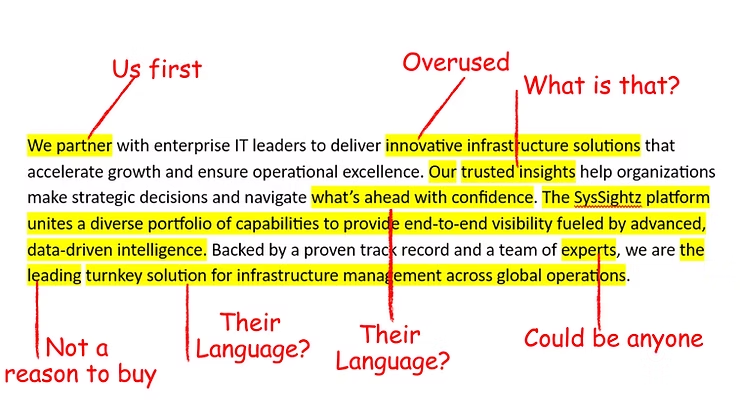
We don't even have to be speaking out loud for the voice problem to show up. When people read our content, they hear it in their heads, and research tells us they're not hearing it in a neutral voice.
The LISN Lab's research suggests that when people read (especially dialogue or emotionally resonant content) they often hear it using a familiar inner voice. Readers may subconsciously cast a voice they already associate with something, like a TV spokesperson, an infomercial narrator, or a radio ad, to interpret the tone and meaning of what they're reading.
That inner voice influences how they emotionally respond to the message.
Think about this email that landed in my inbox:
"Are you tired of long turnaround times and having to work with several agencies on the same campaign? This doesn't need to be the case. With us, you'll get everything from one partner."
What voice did you just hear in your head? I'd bet it wasn't a trusted friend trying to help you. For most people, I would think it would sound like this:
So, it's worth asking ourselves more often: Whose voice is our content being read in? And is that the voice we want?
What It Sounds Like When You Change It
So what happens when we take that same message and write it the way we'd actually talk to someone? Well, it would likely look something like this:
Before: "Are you tired of long turnaround times and having to work with several agencies on the same campaign? This doesn't need to be the case. With us, you'll get everything from one partner."
After: "I know how frustrating it can be trying to manage multiple agencies for one campaign is a lot, especially when timelines start slipping and nobody seems to be talking to each other. If that's something you've been dealing with, I just wanted to offer you a simpler way to handle it all without the usual back-and-forth."
Same message. Very different experience.
The same shift can happen on social media.
Think about how much you're seen (and possibly repeated) the same language in a social media post.

We often convey information the exact same way there as we would in a press release, and then wonder why it doesn't connect.
Before: "We are thrilled to announce the rollout of our new product line!"
After: "Guess what? Our new product is here, and we think you'll love it."
When content feels like it was made for someone instead of announced at them, people respond differently. That's something we've all experienced as consumers. We just forget it when we sit down to write at work.
Where This Shows Up Across Your Content
The good news is that this kind of shift is possible across every format. Here's what it looks like in practice:
In blogs: Get to the point faster. Write like you're trying to help someone learn something, not secretly promote something. Link to outside sources. Avoid writing just to hit a word count or check an internal box.
In podcasts: Talk to one person, not everyone. Give yourself room to speak naturally, even if you're working from notes. Don't follow the same scripted openings every other podcast uses. The "uhs" and pauses that feel like flaws? They're often what makes someone feel like they're in a real conversation.
In video: Same principle — one person, not a crowd. Don't ask people to like and subscribe before you've given them what they came for. Try to sound like you're talking with someone rather than at them.
If any of these feel like areas where your content could sound more like you and less like an ad, that's exactly what we work on together. You can [learn more about working with me here] or [reach out here] if you want to talk through where you are.
The Shift That Changes Everything
There is still a lot of marketing language out there. That's not going away. But if we start asking ourselves, 'Would I actually talk to someone this way?' before we publish, we start creating content that does something marketing language rarely does anymore - it surprises people. Forrester found that's exactly what audiences want from the brands they follow.
The fact that simply sounding human can surprise someone says a lot about where the opportunity lies for your business.
Want more about content language and humanizing content? I sat down with Mike Stelzner at Social Media Examiner to dig into this and the full STAMP framework for humanizing content.
If you want to start making that shift in your own content, whether that's written, podcast, or video, that's exactly what we work on together. You can learn more about how we can work together or just reach out to me, and we'll talk.


Comments